Land and Plots
TP Scheme in Ahmedabad: What TP and FP Numbers Mean, and How to Check Yours
A TP scheme is how Ahmedabad turns scattered holdings into a planned neighbourhood. The authority pools every plot in an area, takes out land for roads, gardens, schools and housing for weaker sections, and hands each owner back a smaller, regular plot. That new plot is the final plot, and its number, the FP, is what appears on sale deeds, jantri tables and GujRERA project addresses.
Buy a plot or a flat anywhere from Shela to Ognaj and the scheme behind it tells you how much land the owner kept, where the roads run and how settled the layout is. Reading it takes an hour once you know where to look.
What is a TP scheme in Ahmedabad?
TP schemes are made under the Gujarat Town Planning and Urban Development Act, 1976. The state’s Town Planning and Valuation Department describes the idea plainly: land under different owners is pooled and redistributed “in a properly reconstituted form”, after deducting land for open spaces, social infrastructure, services, housing for weaker sections and roads. Owners are allotted final plots, preferably close to their original plots.
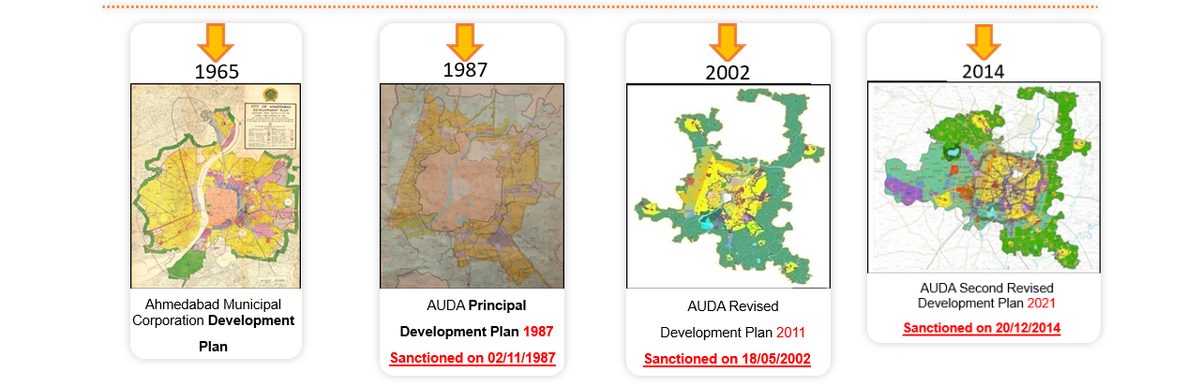
Ahmedabad has used the tool for a century: AMC’s list starts with Jamalpur TPS 1, finally sanctioned on 16 July 1925. Two bodies run schemes today. Ahmedabad Municipal Corporation handles those inside city limits, which now take in Bopal and Ghuma too. AUDA handles the ring beyond, including Shela, Sanand and Chharodi.
What do OP and FP numbers mean?
OP is the original plot: the land as it stood in the revenue records before the scheme, usually one or more survey numbers. FP is the final plot that replaces it. Section 2 of the Act defines a final plot as one “reconstituted from an original plot and allotted in a town planning scheme”.
The FP is rarely the same shape or in exactly the same place as the OP. A long strip of farmland might become a squarer plot facing a new 18 metre road. Neighbours can end up with their plots shifted sideways to make room for a garden.
Once the preliminary scheme comes into force, rights in the original plots end and attach to the final plots instead. That is why a GujRERA project address in Ahmedabad reads something like “Survey No 377/1/3, TP 51, FP 58”. It is also why the jantri tables on GARVI are arranged by TP scheme and FP number in many areas, so the FP is also how you find a plot’s government value.
How much land does a TP scheme take, and why?
Up to 40% is the figure you will hear, and it comes straight from the Act. Section 40(3)(jj) lets the authority take land from the scheme area for these purposes:
| Purpose | Share allowed under section 40(3)(jj) |
|---|---|
| Roads | up to 15% |
| Parks, playgrounds, gardens and open space | up to 5% |
| Social infrastructure such as schools, dispensaries, fire stations | up to 5% |
| Sale by the authority for residential, commercial or industrial use | up to 15% |
A separate clause, section 40(3)(j), reserves up to 10% of the scheme area for housing for socially and economically weaker sections. The Act lets the first three shares change “for the reasons to be recorded in writing”, so the actual cut varies from scheme to scheme.
As an illustration, an owner with 10,000 sq m of original plot in a scheme that deducts the full 40% gets a final plot of about 6,000 sq m. In return the land fronts a planned road and can get development permission. The scheme also works out a contribution the owner pays towards the increase in value, and compensation for land given up.
Our view: never value a plot in a draft or preliminary scheme on its revenue area. Value it on the FP area shown in the scheme, and ask who bears the contribution.
Draft, preliminary and final: what does each stage mean for a buyer?
Every scheme moves through the same stages. The authority declares its intention to make a scheme, prepares a draft and holds an owners’ meeting, and the State Government sanctions the draft. A Town Planning Officer is then appointed, splits the work into a preliminary scheme (plots and layout) and a final scheme (valuation, compensation and contribution), and each is sanctioned by the government in turn.
| Stage | What is fixed | What can still change | What we tell buyers |
|---|---|---|---|
| Draft sanctioned | Road lines and reservations; land for roads and public purposes vests in the authority | FP shape, size and position; contribution amount | Buy only after checking the draft plan; expect adjustments |
| Preliminary sanctioned | Final plots and the layout; rights move from OP to FP | Money figures in the final scheme | Reasonably safe for plot boundaries |
| Final sanctioned | Everything, including compensation and contribution | Only by a formal variation | The most settled position |
The draft stage is the one that surprises people. Under section 48A of the Act, as soon as the government sanctions a draft scheme, the land it needs for roads and public purposes vests in the authority free of all encumbrances. AUDA says its reforms let it take possession of road and social infrastructure land at that point. If part of the plot you are buying sits under a proposed road, you lose it at the draft stage, whatever the 7/12 extract still says.
Section 49 adds a second point. After a scheme is declared, nobody can develop land inside it without permission from the authority, and any permission must follow the sanctioned draft. A seller who promises you can build whatever you like on a plot in a draft scheme is wrong.
Which areas are at which stage?
Here is a sample from the AMC and AUDA lists for the western areas we work in most. Many localities sit in several schemes at different stages, so always check the exact scheme for your survey number.
| Locality | Scheme | Stage | Date |
|---|---|---|---|
| Shilaj | TPS 216 | Final | 11 December 2018 |
| Shilaj | TPS 152/G | Draft | 21 October 2022 |
| Bhadaj | TPS 40 (Sola, Hebatpur, Bhadaj) | Final | 13 April 2018 |
| Bhadaj | TPS 406 | Draft | 24 October 2017 |
| Ognaj | TPS 54 | Preliminary | 27 May 2019 |
| Ognaj | TPS 408 | Draft | 16 September 2019 |
| Ambli | TPS 215 | Preliminary | 4 September 2020 |
| Bopal | TPS 1 | Preliminary | 10 June 2019 |
| Shela (AUDA) | TPS 1, 2 and 3 | Draft | 4 February 2016 |
Shilaj and Bhadaj each have a final scheme and a draft one, so two plots a short drive apart can stand at very different stages. All three Shela schemes on AUDA’s list show only a draft sanction, which matters if you are buying land there rather than a flat in a built project. See what is available in Shilaj, Bhadaj and Ognaj.
How do you check the TP scheme and FP for a property?
Work from the documents outwards.
- Find the TP and FP numbers. They are on the sale deed, the index copy, the property card for city land, and on GujRERA for any registered project. If the seller only gives a survey number, ask for the TP and FP.
- Check the stage. Inside AMC limits, open AMC’s TP Scheme Information page, find the scheme by name and number, and read the current status and its date. Outside, use AUDA’s TP scheme list, which shows the draft, preliminary and final sanction dates.
- Read the F Form. AUDA links one for each scheme, such as the F Form for Shela TPS 1, in Gujarati. It is the redistribution and valuation statement, and Surat’s English Form F for TP Scheme 8 shows the same columns. Find the row for your case and compare the OP area with the FP area.
- Check the plan. Make sure the FP is not shown under a road widening or a reservation, and that its road frontage matches what the seller described.
- For a project, open the developer’s page on GujRERA and look at the plan passing authority and approvals listed against that FP.
The AMC and AUDA pages are free and public, but the drawings can be hard to read. If something does not match, a local town planner or advocate can confirm it before you pay a token.
TP status is one layer of land due diligence. The title checks, from the 7/12 extract to who may buy agricultural land, are in our land buying checklist for Gujarat. If you are still deciding what kind of plot to buy, read our comparison of residential and commercial plots.
Your next step
Send us the survey number, TP number and FP number of the plot you are looking at, and we will tell you its stage and what the scheme shows for it before you commit. Our land and plot advisory does this check routinely, or you can send the details through our consultation page.
Frequently asked questions
What is FP number in property?
FP stands for final plot. When a town planning scheme redraws an area, each original plot is replaced by a reshaped final plot with its own number, and that FP number becomes the plot's identity in the scheme. Sale deeds, jantri tables and GujRERA project addresses in Ahmedabad all quote it alongside the TP scheme number.
How many TP schemes are there in Ahmedabad?
AMC's TP scheme page lists 256 principal schemes, of which 132 are final, 20 preliminary and 104 at the draft stage. AUDA's own list covers another 94 schemes in the wider authority area. New schemes are added every year, so check the live lists rather than any fixed number.
What is F Form in a TP scheme?
The F Form is the scheme's redistribution and valuation statement. For each case it lists the owner, the survey number, the original plot number and area, the final plot number and area, and the money columns for compensation and contribution. AUDA publishes the F Form for each of its schemes as a PDF on its TP scheme page.
What is TP in registration?
In a sale deed or registration entry, TP refers to the town planning scheme number under which the land falls, for example TP 51, and FP to the final plot number within it. Once a scheme is in force, the final plot replaces the original survey number as the unit of land. That is why most deeds in Ahmedabad cite the survey number, the TP number and the FP number together.
What is a draft TP scheme?
A draft TP scheme is the first stage that the State Government sanctions, showing the proposed roads, reservations and final plots. Under the Act, land needed for roads and public purposes vests in the authority as soon as the draft is sanctioned. Plot shapes and money figures can still change at the preliminary and final stages.
Sources
- Gujarat Town Planning and Valuation Department: Town Planning Scheme
- Gujarat Town Planning and Urban Development Act, 1976 (Town Planning and Valuation Department)
- AUDA: TP Scheme list with F Forms
- Ahmedabad Municipal Corporation: TP Scheme Information
- Surat Municipal Corporation: Form F, Final TP Scheme No. 8 (Umarwada)
- AUDA: F Form for Shela TP Scheme No. 1
- GujRERA
Talk it through with us
Call us on +91 98249 00778 or send us your question.